

Most Shopify brands don’t think much about their store locator at first. A few retailers, a simple map…done.
But things change quickly once wholesale, distributors, franchisees, or retail expansion enter the picture. What worked at 15 locations starts becoming messy at 150.
Marketing teams want branded experiences, operations teams want easier location management, retail partners want visibility, customers expect filtering, fast search, and mobile-friendly experiences.
Suddenly the “simple store locator app” becomes operational infrastructure. This is usually the point where brands realize not all store locator apps are built for the same stage of growth.
Some are optimized for simplicity, others are built for scalability.
This guide compares some of the most popular Shopify store locator apps in 2026, especially for brands planning to grow their retail or dealer network over time.
What Shopify Brands Actually Need From a Store Locator
At first glance, most Shopify store locator apps look similar. A Map with a search bar, some pins, and that's it. But once brands start managing dozens or hundreds of locations, the requirements change quickly.
Especially for brands dealing with:
- retail partners
- distributors
- franchise groups
- international expansion
- multiple brands
- “where to buy” experiences
This is where teams start realizing they need more than a basic map. Features that suddenly become important:
- filtering
- bulk location management
- branding flexibility
- multiple maps
- custom fields
- operational workflows
- analytics
- scalability
This is also where many brands realize they accidentally optimized for “easy setup” instead of long-term flexibility.
Best Shopify Store Locator Apps Compared
Storemapper
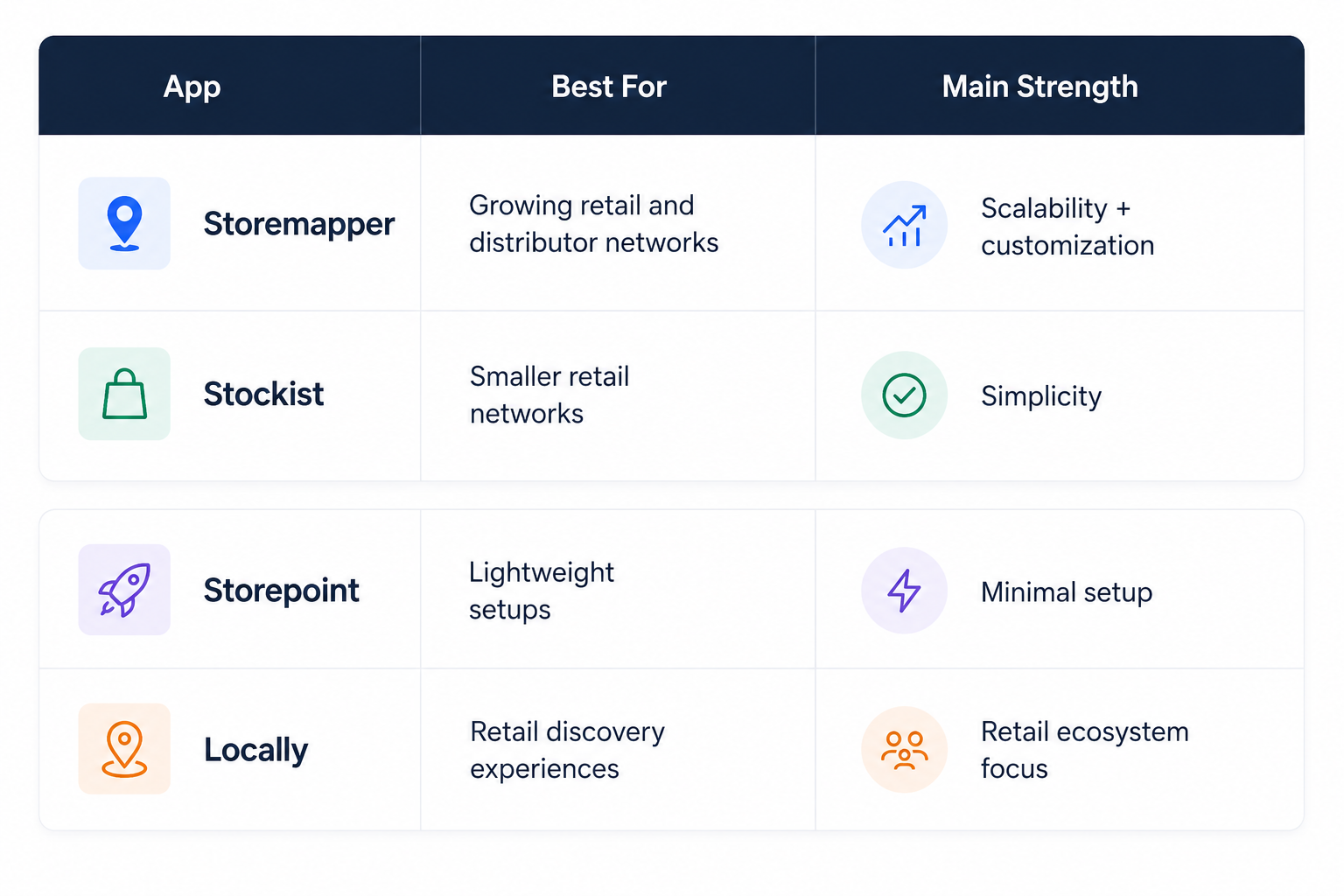
Best for growing retail, dealer, and distributor networks. Storemapper works especially well for Shopify brands that expect operational complexity to increase over time.
That usually starts happening around:
- 50+ locations
- multiple distributors
- franchise groups
- regional retail teams
- international expansion
At first glance, many store locator apps look similar. But things change quickly once teams need to:
- manage hundreds of locations
- separate dealer and retail experiences
- customize branding
- filter large location networks
- bulk update store data
- manage multiple maps
This is where many simpler locator setups start becoming limiting. One of the biggest differences with Storemapper is flexibility without needing a fully custom build.
For example:
- multiple maps can be managed from one account
- filters help customers navigate large retail networks
- custom fields allow brands to add buttons, logos, images, and HTML inside location cards
- bulk uploads simplify large updates
- Google Business Profile import reduces manual work
- Google Drive sync helps teams keep location data updated centrally
And honestly, branding is one of the most overlooked parts of store locator UX. A locator that looks visually disconnected from the rest of the website quietly hurts trust.
Storemapper includes custom CSS support directly inside the subscription, which allows brands to create locator experiences that actually feel native to their website instead of looking like a third-party widget dropped into the page. See Storemapper live demo.
This becomes especially important for premium ecommerce brands where brand consistency matters heavily.
Suggested for:
- growing Shopify brands
- dealer and distributor networks
- franchise businesses
- multi-brand portfolios
- teams needing operational flexibility
Stockist
Best for brands prioritizing simplicity and fast setup.
Stockist became popular with Shopify brands because the setup experience is straightforward and the frontend experience feels clean right out of the box. For smaller retail networks, that simplicity is genuinely valuable.
Especially for:
- early-stage ecommerce brands
- smaller wholesale programs
- brands with relatively simple location structures
But here’s where things usually change. As retail networks grow, teams often start needing:
- more advanced filtering
- more branding flexibility
- multiple maps
- bulk operational workflows
- more customizable location experiences
This is typically the point where brands start evaluating more scalable locator platforms. Stockist still works very well for businesses that prioritize:
- fast implementation
- simpler retail discovery experiences
See how Storemapper handles larger retail and distributor networks on Shopify.
Storepoint
Best for lightweight store locator setups, Storepoint focuses heavily on simplicity.
For brands that only need a straightforward locator experience without many advanced operational requirements, that can work perfectly fine. But once brands start expanding distribution or involving multiple teams, limitations around customization, filtering, branding flexibility, operational management and scaling workflows usually become more noticeable.
Suggested for:
- smaller retail networks
- simpler ecommerce workflows
- basic store locator needs
Locally
Best for retailer discovery experiences. Locally focuses heavily on helping shoppers discover nearby retailers carrying a brand’s products. That creates a slightly different experience compared to traditional store locator platforms.
For brands heavily focused on retail sell-through and retailer visibility, this model can work well.
But for teams needing:
- more branding control
- embedded website experiences
- multiple maps
- deeper customization
- operational flexibility
…a more customizable locator platform may make more sense.
Suggested for:
- omnichannel retail brands
- retailer discovery workflows
- retail visibility initiatives
What Usually Breaks as Retail Networks Grow
This is the part most store locator comparisons ignore. Managing 20 locations is very different from managing 500, and operational problems appear much faster than most brands expect.
Here’s what usually starts breaking first:
Location Management Becomes Manual
Updating hundreds of locations one by one quickly becomes painful, especially for:
- seasonal hours
- distributor updates
- regional changes
- product availability
This is where bulk uploads and centralized management become critical.
Customers Struggle to Find the Right Locations
A simple search bar works fine for smaller networks. But once brands grow, customers often need filtering for:
- retailer type
- services
- products
- availability
- pickup options
- regions
Without filtering, large store locators become frustrating to use.
Branding Starts Feeling Disconnected
Many locator tools still look visually separated from the rest of the website. For premium ecommerce brands, this creates a surprisingly poor user experience. This is where branding flexibility and custom CSS become much more important.
Multiple Teams Need Access
As retail operations grow, different teams usually need different workflows. For example: marketing teams, franchise operators, regional managers, distributors, ecommerce teams, etc.
Trying to manage all of this inside a basic locator setup becomes difficult very quickly.
Which Shopify Store Locator App Fits Your Business Best?
Choose Storemapper if:
- You expect your retail network to grow
- You manage distributors or dealers
- Branding flexibility matters
- You need advanced filtering
- You want multiple maps
- Your team manages large location updates
- You need more operational flexibility over time
Explore Storemapper’s pricing.
Choose Stockist if:
- Your retail network is still super small
- You want to add pins on a map
- Simplicity matters more than scalability
- Your operational requirements are still straightforward
Choose Storepoint if:
- You need a more minimal store locator setup
- Your requirements are relatively simple
- You prioritize ease of setup over advanced workflows
Choose Locally if:
- Retail discovery is your primary focus
- You want shoppers to find nearby retailers carrying your products
- Your strategy is heavily retail-partner driven
Final Thoughts
Most brands don’t think much about their store locator early on, then retail growth starts accelerating and suddenly the locator becomes one of the most visited pages on the website.
That’s usually the moment teams realize this isn’t just a map anymore, it’s part of the customer journey. And choosing a platform that can grow with the business becomes a much bigger decision than expected.
If your Shopify store locator is starting to feel limiting as your retail network grows, this is exactly where Storemapper fits. Test your own locations, branding, filters, and workflows with a free trial and see how the platform handles larger retail and distributor networks.
Explore how Storemapper works or start a free trial and test the platform with your own locations, branding, and workflows.
FAQ
What is the best Shopify store locator app?
The best Shopify store locator app depends on the size and complexity of the retail network. Smaller brands often prioritize simplicity, while growing brands usually need more operational flexibility, filtering, branding control, and bulk location management.
What features should a scalable Shopify store locator include?
Scaling brands usually need:
- filtering
- bulk uploads
- branding customization
- multiple maps
- location management workflows
- analytics
- Google Business Profile integrations
These features become more important as retail networks grow.
Can Shopify store locator apps support multiple maps?
Some store locator platforms support multiple maps from the same account, which is especially useful for franchise groups, international brands, distributor networks, or multi-brand portfolios.
Why do growing brands outgrow basic store locator apps?
As retail operations become more complex, brands often need:
- more advanced filtering
- centralized management
- branding flexibility
- multiple workflows
- operational scalability
This is usually where simpler locator setups become limiting.
Can I customize a Shopify store locator to match my website?
Yes. Some platforms allow custom CSS and advanced branding controls so the locator experience feels visually integrated with the rest of the website instead of looking like a third-party widget.


